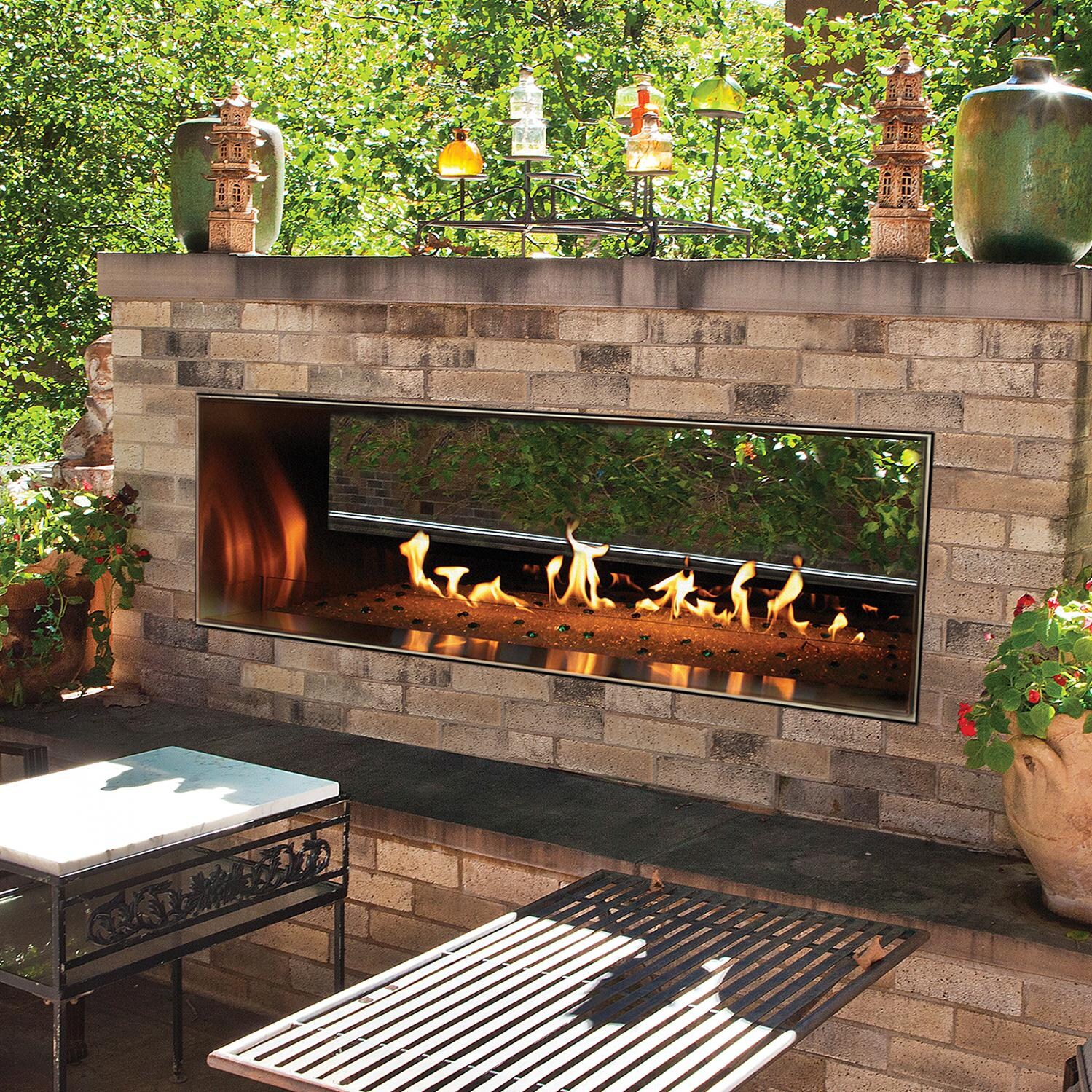
Gas Log Introduction
Don't forget to visit our Gas Log Videos section for help on installing gas logs and more!
Advantages of Gas Logs
- Gas logs cost a fraction of what wood logs cost per hour to operate.
- Since gas logs do not require electricity, the are a great source of heat and light during a power outage.
- Gas logs can be conveniently started at the turn of a valve or with an on/off switch.
- They offer enjoyment year after year without having to worry about stocking and replacing firewood.
- Dangerous flying sparks and dirty ashes are eliminated. Creosote build-up in the chimney, a common cause of fires, is also eliminated by the clean burning gas fuel.
- Gas logs burn cleaner than wood, reducing air pollutants.
- Once the logs are in place they are permanent. No constant hassle with the changing out of real wood logs.
- Real wood requires approximately 3 hours of burn time. Gas logs operate by a simple on/off valve and usually do not have limits to burn time.
|
Determine Which Style of Fireplace You Have:
| |
|
How many openings your fireplace has will determine whether you should choose a "standard" or "see-thru" gas log set."
| |
![]() Standard Fireplace |
Standard Standard gas log sets are for fireplaces that have an opening on only 1 side. This is the category that most fireplaces will belong to. |
![]() See-Thru Fireplace
|
See-Thru
See-Thru gas log sets are for fireplaces that have openings on both sides (like a fireplace that has an opening facing your den and one facing your dining room). You can also place "See-Thru" gas log sets in peninsula fireplaces (openings on 3 sides). "See-Thru" log sets are "finished" on all sides so they look very nice from any angle. Standard gas log sets are only "finished" on the front side. |
|
Back To Top
| |
The absolute best place to measure your firebox is left to right, approximately half-way back in the firebox (the midpoint). This is usually where the widest part of any log set would sit and it is recommended to have at least 3 - 6 inches of clearance on each side of the widest log.
Watch This Video
How To Measure Your Fireplace
|
Easy way to get this midpoint measurement: 1. Measure the width of your front opening* (FW) 2. Measure the width at the rear of your fireplace (RW) 3. Add the front width and rear width together (FW + RW) 4. Divide that total by 2 ((FW + RW)/2) 5. The result is your midpoint measurement!! (M = (FW + RW)/2) * Please note - it is best to measure your front width in relation to your usable floor area. Your fireplace may have a wider opening to allow for a door or screen. Notice in our pic we are measuring the front of the floor vs. the actual widest part of the opening |
To determine the correct log size, simply follow these steps:
|
Enter Width In Inches: |
Select Ignition Type: ![]() Matchlight Manual Safety Pilot Remote Control |
|
|||||||
**PLEASE NOTE**
- This guide is for standard fireplaces only. If you have a see-thru or peninsula fireplace, please click here.- This guide does not factor in where your gas supply pipe comes into your fireplace. Click here for more info about this.
- This guide does not take into account the depth of your fireplace floor. Most log sets require at least 15 inches of depth. If you have less than 15 inches, you may want to refer to our more detailed sizing specs to make sure of the right set. If you have a fireplace that requires a log set wider than 36 inches, you may require more depth.
"Vented vs. "Vent Free" - Determine What Type of Gas Logs You Need:
Do you want a realistic looking, wood fire substitute? Are you more interested in the most efficient way to heat your home? Here are some facts that should help you choose between a vented or vent free gas log set.
View a Video on Vented vs Vent Free Gas logs
Vented Gas Logs:
- These logs must be installed in a fireplace with a fully functional chimney, to draft the smoke and combustion gases from your home.
- These log sets have been available for over 50 years and are still the most popular.
- Vented logs are the logs that most resemble a realistic wood fire.
- They use an open damper, which limits heating efficiency. Just like burning a wood fire, most heat escapes the chimney and only a small amount is returned to your home.
- Vented log sets are more flexible. Logs can be repositioned according to preference.
Vent Free Gas Logs: (Non-Vented)
- Vent Free(also known as non-vented, unvented or ventless)logs do not require a chimney.
- They keep 99 percent of the heat produced in your home, and are very efficient as a primary heat source.
- All units are equipped with an ODS (Oxygen Depletion Sensor). This device cuts the flame off if the oxygen level in the air drops below a safe level. This situation is very rare.
- Vent Free logs cannot be repositioned once they are installed. This is due to vent free log sets having to maintain a complete clean burn which requires the logs to sit on the grate in only one way.
- Some states (California, Massachusetts, and a few others) require special permits in order to operate non-vented appliances indoors. It is the customer's responsibility to know his or her local codes and limitations.
Propane vs. Natural Gas Logs
View a Video on Propane vs. Natural Gas Logs
How Are These Gas Logs Different?
One of the first things you may notice about gas logs when you begin shopping for the right one is that they are available
in either Natural Gas (NG) or Propane (LP) versions. Natural Gas is more common and frequently used in urban areas, which makes
it a popular choice for gas logs. Other gases burn hotter than natural gas does, but natural gas is cheaper. Propane contains
more carbon than natural gas, and it burns much hotter. That does not mean that propane gas logs are warmer than natural gas-fueled
log sets. Heat outputs of various gas logs can be accurately compared using BTU measurements. Liquid propane is most commonly
used in areas where natural gas is not available and mostly in rural areas.
Which Gas Log Should You Choose?
Deciding which gas log type to purchase is easy. In many cases, you can simply choose a gas log that will work with the fuel source that is already available in your home. If you have a natural gas heater, dryer, stove, or other gas appliance, then natural gas logs are the obvious choice. Conversely, if you heat your home with propane, a liquid propane gas log is the way to go.
If your home is not plumbed for either of these fuels, check locally to determine which fuel makes most sense to use in your home and then purchase the appropriate log set.
Natural Gas:
Natural gas is lighter than air, which means natural gas appliances, including gas logs, can be used without a safety pilot in many areas (again, check with your local fuel provider to be sure). Natural gas must be hand-piped to a gas log from existing service lines that are buried in your area.
If you already have natural gas in your home, but do not have it plumbed to your fireplace, a certified plumber should be able to run the lines for a gas log. Your plumber will use the BTU output to determine the proper line diameter that your gas log requires.
Propane:
Unlike natural gas, propane is heavier than air. It is stored in a reinforced tank positioned outside the home. A certified plumber or propane professional would install the line that runs from this tank to your fireplace and thus into your gas log set.
All gas logs that use propane require a safety pilot. The safety pilot on propane gas logs prevents propane gas from accumulating inside the home if someone were to turn on the gas without lighting a flame on the gas log set.
Determine Your Ignition Method
|
Did you know you can choose how you want to light your gas log set? Many of our gas log sets come with several different lighting options. They may slightly differ by brand but basically you can choose from:
| |
|
| |
|
| |
|
| |
|
| |
|
| |
|
| |
|
| |
| Back To Top | |
Installing Your Gas Logs
It is highly recommended that your new fireplace logs be installed by a qualified plumber or heating contractor. This is not the right job for a DIY. Most jobs are installed with threaded pipe, which must be cut and threaded on the job. In addition, technical knowledge and certain instruments are required to set up and adjust the gas logs. Installation prices can vary, usually running from $200 to $350 for a basic job. It is well worth it for the peace of mind--support your local contractor!
Need more information about Gas Logs? Call Toll-Free: 1-877-743-2269
Gas Log Certification Details
Some areas of the country have different requirements for gas log burners than others. It is the customer's responsibility to choose a set that conforms with his/her local requirements. Contact your local government office or gas company for any information regarding requirements in your area.
In a nutshell, some areas require that a gas log burner must have a factory installed safety pilot kit and must be certified to certain ANSI standards. CSA is the Canadian Standard Association, formally known as AGA (American Gas Association). These are independent testing agencies that test to the ANSI (American National Standards Institute) Standards. For nearly ninety years, ANSI has served as the coordinator of the U.S. voluntary standards system. Omini, UL, Radco as well as some others, are other testing agencies. Some areas or inspectors may require CSA only (or any other particular testing agency) because this is what they are familiar with, but in actuality it is the Standard for that area that counts, not the agency that tested it.
Some areas of the country require the use of a safety pilot kit but it doesn't have to be factory installed, meaning it can be installed on to the burner at the time of installing the gas log set into the fireplace. There is no ANSI standard for this, ANSI only sets standards for burners with factory installed safety pilot kits.
Some areas don't require the use of a safety pilot kit at all but might require that the gas log burner only be Radco listed.
And finally, most of the areas throughout the country don't have any requirements for gas log burners. In these areas, the customer can choose any set he/she wants to install.
Below is a table showing the different burners we carry from each manufacturer, which certification standards they meet and which testing agency verified those standards. Below that is the description of each ANSI standard.
| Manufacturer | Burner Model | Standard | Testing Agency |
| Peterson | G4 (12"-30") | listed | Radco |
| Peterson | G4 (>30") | none | none |
| Peterson | G45 | listed | Radco |
| Peterson | G46 | ANSI Z21.60 | CSA |
| Peterson | G8 | ANSI Z21.60 and Z21.11 | Omni |
| Peterson | G9 | ANSI Z21.60 and Z21.11 | Omni |
| Peterson | G10 | ANSI Z21.60 and Z21.11 | Omni |
| Peterson | G18 | ANSI Z21.60 and Z21.11 | Omni |
| Peterson | FPB55 | ANSI Z21.60 | Omni |
| Peterson | EPIC | none | none |
| Peterson | G45-GL | listed | Radco |
| Peterson | PB | listed | Radco |
| Peterson | G4-SS | listed | Radco |
| Rasmussen | C2 | ANSI Z21.60 and Z21.11 | CSA |
| Rasmussen | F, FX | listed | Radco |
| Rasmussen | CS, CA | none | none |
| Rasmussen | CXF, CXFA | none | none |
| Rasmussen | TNA | none | none |
| Rasmussen | LC, LD | none | none |
| Monessen | All Vent Free | ANSI Z21.60 and Z21.11 | CSA |
| Monessen | All Vented | ANSI Z21.60 | CSA |
| Description of ANSI Standards | |||
| z21.60 | VENTED DECORATIVE APPLIANCE | ||
| z21.11 | UNVENTED ROOM HEATER | ||
Back To Top